
News & Sector Analysis | 19-11-2026
UPI MDR Charges: 0.4% P2M Fee & Flat ₹5 Cap Related To Indian Sectors
Summary
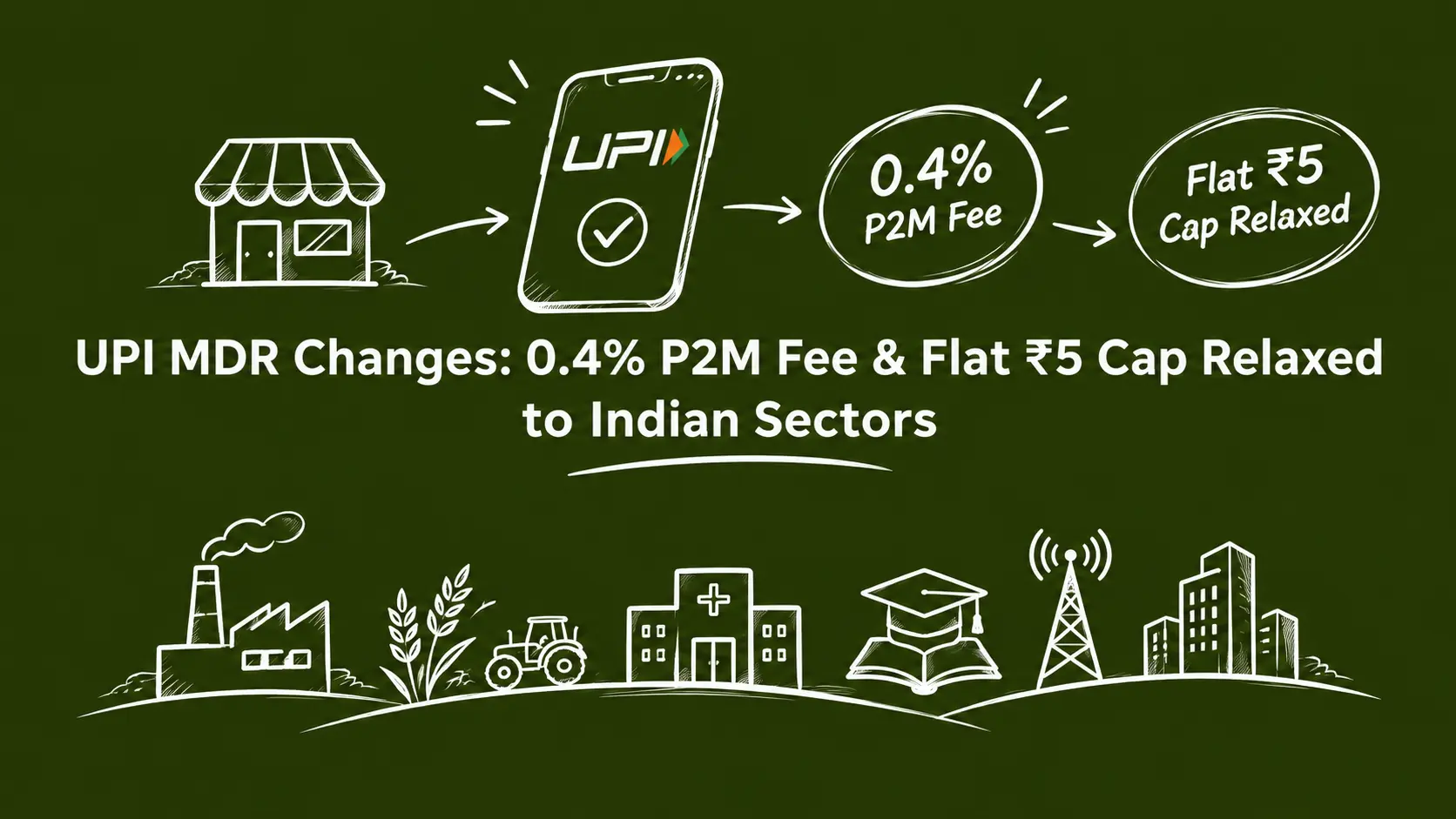
The payments industry is urging the government to implement proposed UPI MDR charges following the peak festival season—featuring a 0.4% fee (capped at ₹300) on person-to-merchant (P2M) payments above ₹2,000, and a flat ₹5 fee for essential categories such as railways, telecom, insurance, and fuel, the final government approval remains pending. Because UPI is the core digital payment rail for Indian commerce, market observers are closely tracking how this fee structure connects to key Indian stock market sectors, particularly Fintech & Payment Aggregators, Banking & Financial Services, Organized Retail & FMCG, and Oil & Gas (Fuel), Telecom & Insurance. Below is a factual breakdown of what happened and why these businesses are related
What Happened? Key Facts
1. Rising Operational Costs: Due to stricter regulatory compliance and a surge in AI-driven cyberattacks, operational expenses for payment firms have risen sharply. With the festival season ending, industry executives have asked the government to roll out Merchant Discount Rate (MDR) fees.
2.Delay in Government Incentives: According to industry reports, some fintech companies recorded expected government incentives as revenue in their accounting books even before the funds were credited. The Payments Council of India (PCI) has raised concerns with the Finance Ministry over both unpaid incentives and the delay in implementing UPI MDR charges.
3.NPCI’s Revised Fee Structure: Under the framework approved by NPCI’s UPI and Services Steering Committee:
4. Standard Merchant Payments (P2M): Transactions above ₹2,000 attract a 0.4% MDR fee, capped at ₹300 per transaction.
5. M2M & Essential Sectors: Payments above ₹2,000 for merchant-to-merchant (M2M) settlements,and essential services (railways, telecom, insurance, and fuel) carry a flat fee of just ₹5.
7.Pending Final Approval: With several state elections scheduled in 2027, final government clearance on this issue
RELATED INDIAN STOCK MARKET SECTORS
Sector 1: Fintech & Payment Aggregators
Sector 2: Banking & Financial Services
Sector 3: Organized Retail & FMCG
Sector 4: Oil & Gas (Fuel), Telecom & Insurance
How They Are Related:
1. Fintech & Payment Aggregators
Payment aggregators and fintech platforms are directly connected to this news because they build and operate the digital payment gateways and QR infrastructure that merchants use every day. For years, these companies processed UPI transactions at zero MDR while absorbing rising server and AI-cybersecurity costs, relying heavily on delayed government subsidies. Introducing structured UPI MDR charges creates a direct, recurring revenue stream for their business and reduces their dependence on government payouts.
2. Banking & Financial Services
Public and private sector banks are connected because they manage the core banking servers and settlement networks required to clear every UPI transfer. Handling billions of monthly transactions requires heavy investment in IT infrastructure, fraud detection, and regulatory compliance. A share of the MDR helps banks recover these operational expenses, while keeping person-to-person (P2P) transfers free and capping fees at ₹5 for high-frequency utility and essential payments keeps everyday users and billers active on digital banking rails.
3. Organized Retail & FMCG
4. Oil & Gas (Fuel), Telecom & Insurance
Fuel retailers, telecom operators, and insurers are connected because they collect millions of high-value recurring payments—such as commercial fuel refills, broadband bills, and insurance premiums—that routinely exceed ₹2,000. Under a percentage-based fee, high-ticket digital collections would trigger steep payment gateway deductions. Placing these essential industries under the flat ₹5 fee tier shields their business margins from percentage-based transaction cuts, especially for fuel companies already navigating elevated fuel and power costs.
Related Market Context
Payment processing costs are just one piece of the broader cost environment facing Indian businesses. Rising energy and raw material expenses—such as October’s surge in wholesale inflation led by fuel and power—continue to influence operating margins across retail, logistics, and manufacturing sectors.
Source: Business Standard
Disclaimer: I am not a SEBI-registered investment advisor or research analyst. The information in this post is shared for general awareness and educational purposes only, based on publicly available news reports. It is not investment advice, a recommendation, or an offer to buy or sell any security. The sector discussion is general economic reasoning and does not predict how any company or stock will perform. Investing in the stock market involves risk, including loss of capital. Please do your own research or consult a SEBI-registered financial advisor before making any investment decision.
– The End –